The Psychology Behind Effective Email CTAs
A great email can fall flat if your call-to-action (CTA) doesn’t compel readers to click. Understanding the psychology behind CTAs helps marketers drive more clicks, conversions, and revenue.
In 2025, with attention spans shorter than ever, knowing how to structure and phrase your CTAs is crucial for email marketing success.
Why Email CTAs Are So Important
- Guide subscribers: Tell them exactly what to do next
- Increase conversions: Clear CTAs improve click-through rates
- Create urgency: Encourage immediate action
- Measure success: Track which CTAs perform best for optimization
Stat: Emails with a single, clear CTA see 371% more clicks than emails with multiple or vague CTAs.
Key Psychological Principles Behind Effective CTAs
1. Clarity Over Creativity
- Your CTA should clearly communicate the action
- Avoid confusing or vague phrases like “Click here” without context
- Example: “Download Your Free Marketing Checklist”
2. Urgency and Scarcity
- People respond to limited-time offers or exclusivity
- Words like “Now,” “Today,” “Limited,” trigger action
- Example: “Claim Your Spot Before It’s Gone”
3. Benefit-Oriented Language
- Focus on what the reader gains, not what you want
- Example: “Boost Your Email Open Rates in 7 Days” instead of “Learn About Email Marketing”
4. Visual Hierarchy
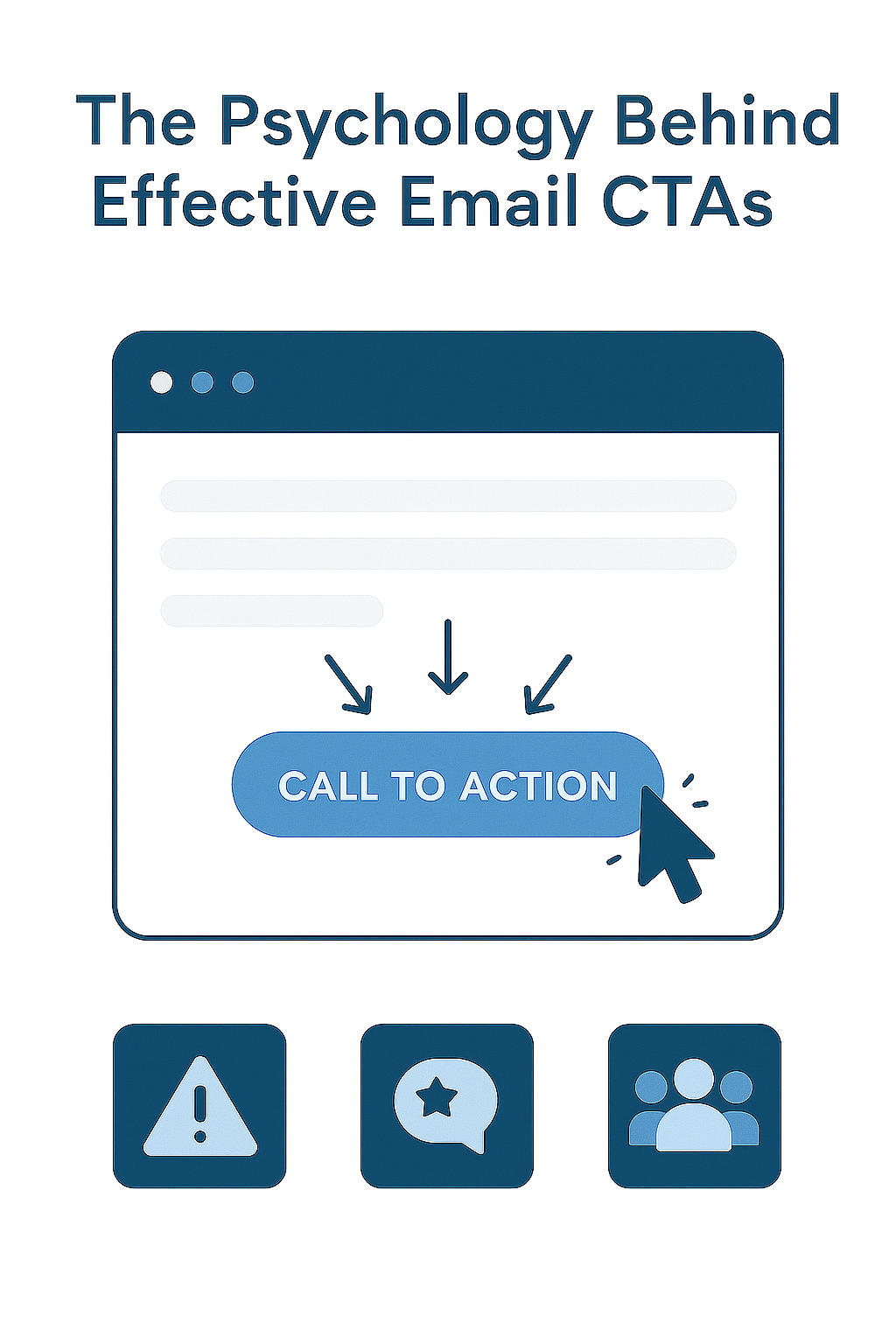
- Use buttons, colors, and whitespace to make the CTA stand out
- Ensure mobile optimization — many users open emails on smartphones
5. Social Proof
- Adding endorsements or stats can increase clicks
- Example: “Join 10,000+ marketers who’ve improved their email campaigns”
6. Action-Oriented Verbs
- Use strong verbs that drive action: Get, Download, Start, Claim, Reserve
- Avoid passive words like “Learn” or “Read” without a compelling reason
Best Practices for Email CTAs
- Limit to One Primary CTA
- Multiple CTAs can confuse readers and reduce clicks
- Test Different Variations
- A/B test colors, copy, size, and placement
- Position Strategically
- Above the fold or repeated in longer emails
- Align With Content
- Ensure the CTA matches the email’s message and offer
- Personalize When Possible
- Example: “John, Get Your Personalized Report Now”
Examples of High-Converting CTAs
- “Start Your Free Trial Today”
- “Download Your Exclusive Guide”
- “Reserve Your Spot Before Seats Run Out”
- “Boost Your Sales With This Tool”
Final Thoughts
Effective email CTAs are a blend of psychology, clarity, and design. In 2025, marketers who:
- Use clear, benefit-driven language
- Create urgency and social proof
- Design visually appealing buttons
…will see higher engagement, click-throughs, and conversions.
💡 Test, analyze, and refine your CTAs continuously — even small improvements can have a massive impact on results.